In May 1922, Pancho Villa arrived in the United States from the Philippines and won his first overseas fight against Abe Goldstein in Jersey City on June 7, 1922. Following a series of quick successes that year, he caught the attention of boxing enthusiasts and was scheduled to fight American Flyweight Champion Johnny Buff in September. The fight drew the attendance of Jersey City’s mayor, FrankHague, as Buff was a local favorite.
As Villa’s reputation grew, he set his sights on the vacant World Flyweight Championship, which was to be contested in the U.S. He went on to defeat Welsh-born boxer and former World Flyweight Champion Jimmy Wilde.
After World War I, American soldiers were stationed in the Philippines, including Mike Ballerino, a private from New Jersey. At the time, boxing in the Philippines was still in its early stages. Ironically, Villa and Ballerino fought multiple times in matches that lasted 20 rounds. Ballerino later became a Middleweight champion, while Villa remained the Flyweight champion. The two would never meet again in New Jersey.
The 1920s also saw the arrival of Filipino seafarers via the Atlantic Ocean, ferrying immigrants to Ellis Island. Among them were organizers of the Knights of Rizal, Inc., a Filipino organization distinct from the Knights of Rizal in Manila.
Pictured
(seated left to right) Anastacio Q Liaguna, Eduardo H Reyes, Mamerto M Buenafe, Mrs Thedora Abaya (Mother Advisor), Miss Louise Ruth Shapiro (Legal counsel), Eduardo Orna,Albert C Young, Julian Tabletan,
(second row) Honofre G Javier, Higino G Navar, Jose R Asuncion, Vicente N Bellaran, Afredo M Alvarez, Eulogio D Jutie, Ê
(third row) Miguel V Macabay, Alfonso C Barredo, Estanislao T Bantog, Jose P Cabansag and Esteban Macaso
Vicente Bellaran, Julian Tabletan, Eduardo Orna, Alfonso C Barredo, Higino Navar, Alfredo Alvarez, and Astanaslas (Estanislao) Bantog are listed on the Ellis Island Data Center.
Astanaslas (Estanislao) Bantog was born in Calumpit, Philippines, on May 7, 1892. He arrived in the United States on June 11, 1917, standing 5’7″ and weighing 159 lbs. Later, he changed his name to Stanley. He worked as a wiper/fireman and traveled aboard the ship St. Paul with Santiago Dela Coucha (born July 25, 1885, in Subic). Both were listed as crewmembers in the Ellis Island Historical Family records, ferrying immigrants to Ellis Island during the early 1900s.
Other crew members included individuals with last names like Asuncion, Jutie, and Abaya, who may have been related to one another. These names appeared multiple times across separate voyage manifests. Some members of the Knights of Rizal were also likely mariners, though assigned to ships that did not transport passengers to Ellis Island. Unlike early Filipino pioneers in Hawaii and the West Coast—who primarily worked as contract laborers on farms (sacadas), in Alaskan salmon canneries (Alaskeros), or as pensionados (government-sponsored scholars)—Filipino sailors were among the first to settle on the East Coast. The Filipino community there remained small due to the great distance between the Philippines and the Eastern Seaboard. However, the completion of the Panama Canal allowed for more direct passage, eliminating the need to travel via Europe or around the Strait of Magellan.
Between 1892 and 1924, over 22 million passengers and ship crewmembers were processed through Ellis Island and the Port of New York (ref: American Family Immigration Center). Many Filipino mariners were among them, playing a role in transporting millions of new immigrants. By the final years of this period, Filipino-Americans made up nearly 20 percent of ship crews.
On February 25, 1889, Rizal’s friend, Graciano López Jaena, wrote in La Solidaridad (a Filipino propaganda newspaper in Europe) about the presence of Filipino sailors in Barcelona. He also noted that Filipino seamen could be found in nearly all major ports of England, France, and the United States, including New York and Philadelphia. Official immigration records listed their ethnic classification as either “Filipino” or “Philipino.” Some Filipino immigrants first settled in Europe before relocating to the East Coast via Ellis Island.
At that time, ocean liners unloaded first-class passengers directly in New York City, while other passengers were sent to Ellis Island for immigration processing. Those who gained entry through the portal of Jersey City (now Liberty State Park) continued their journey into America.
The immigration system changes in the 1970s generated the coming of more professionals in Jersey City. Accountants, Engineers, and others, other than medical practitioners, landed in downtown Jersey, an easy commute to New York. They found positions in City Hall and had a chance to participate in politics. Linda Mayo became a Deputy Mayor, Serafina Sengco became Chief Financial Officer, and others became leaders in the Finance and Accounting departments. Rolando Lavarro tried the mayor’s post but came short. In real estate, the landscape quickly went to Greg Racelis.
Why October is the Filipino American History Month: my 100 years of research. Comparing the history of slavery and the colonization of native tribes and building empire building, historians often forget the differences.
Filipino American History is celebrated in October. It marks the first landing of Filipinos in America. This event occurred at the same time Spanish Florida began in St. Augustine. My extended version of World history focuses on the nuances of slavery. These nuances occurred as a forgotten consequence between the two mighty empires and religions.
By defining October 18, 1587, Filipinos first landed at Morro Bay 435 years ago. The 16th century of exploration and discovery began with King Charles I, better known as Charles V. The Holy Roman Emperor sent Magellan’s armada on a journey to the New World. This mission aimed to spread Christianity. It followed Charlemagne’s earlier crusade to the Middle East but headed in a westerly direction. The Papal Bull or decree, “Inter Caetera,” in 1493 divided the world. It authorized Spain and Portugal to colonize the Americas. They could treat its Native peoples as subjects. Embedded is how the subjects are treated. I am not justifying colonization. However, I want to underscore that the Holy Roman Empire edict permanently embedded Slavery.
Comparing how Spanish and English colonists treated slaves
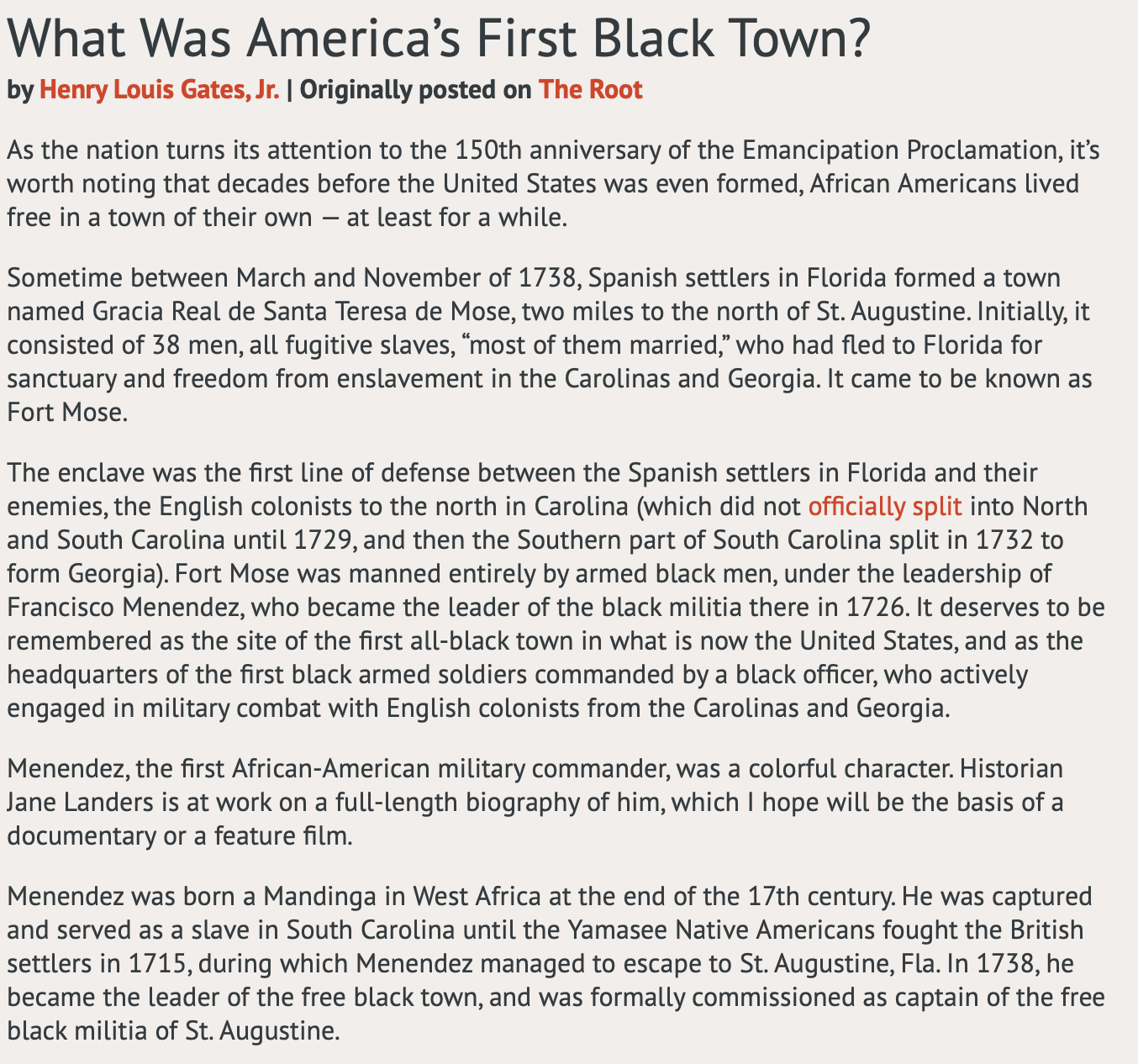
When British forces from Georgia attacked St. Augustine in 1740, Governor Montiano ordered the inhabitants of Fort Mose to abandon their settlement and retreat to St. Augustine for safety. The British captured Fort Mose and used it as a base of operations. However, the Spanish soldiers and Mose militia launched a surprise counterattack. They devastated the British forces and regained the fort. However, the fort was destroyed in the process. For the next decade, the people of Mose lived in St. Augustine until Governor García de Solís insisted they return and rebuild their settlement in 1752. When Florida was ceded to Britain in 1763, these African settlers, along with other Spanish citizens, evacuated to Cuba.
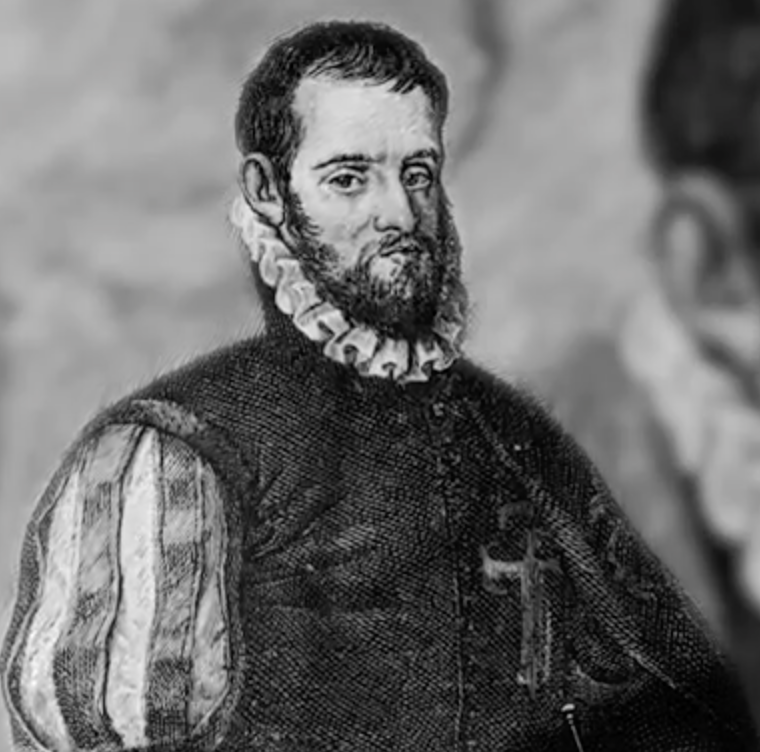
When Pedro Menéndez de Avilés established St. Augustine in 1565, he was accompanied by both free and enslaved Africans. These Africans played crucial roles in building the settlement. They constructed fortifications and cleared land for crops. They also helped build the early structures, including a church, a blacksmith shop, and an artillery platform.
The day we landed in America in Morro Bay, onboard were the Indios Luzones. The nephew of St Ignasious led the Filipino crew ashore. They claimed the land for the cross for the Holy Roman Empire, not for Spain. The Galleion ship was flying the banner of the Supreme Holy Emperor. Even going back on April 21, 1522, Magellan came to the Philippines. He did not intend to colonize but aimed to spread the Catholic persuasion. You will see this influence afloat in Cebu. I also noted that the country was named Philippines after the prince pretender Philips II. He was later excommunicated by the Roman Emperor for serious unbecoming. That’s our Genesis. Guam was named the Island of Ladrones until the Americans came. In my little geography, the Philippines was always on American time. This lasted until Governor Claverra’s mass baptism of native Filipinos in the mid-19th century. He decided we would no longer follow American time but be in the Asian share. The town of Claveria was born, where our historian Thelma Bucholdd was born. This necessitated losing one day, making it so that no Filipino was born on December 31, 1849. If you are puzzled, watch the movie Around the World in 80 Days.
Magellan’s stay in the Philippines and the Filipinos landing on Morrow Bay are not just a coincidence. It was the Tudor era, which was also the era of Shakespeare. This period was also the reign of Carlos I, better known as King Carlos, and his son, Phillip II. The First Queen Elizabeth reigned during this time too. They were all cousins. Marrying each other was the norm of that time. Phillip II courted the royal family, especially Queen Mary, but he failed. He returned to marry Isabella. Slowly, England separated from the Roman Empire. They went on to build the Church of England. Protestants came to join in flocks. The Roman Empire secretly survived when the Filipinos landed in America. In 1587, on the coast of Florida, the Spaniards were giving the English a hard time by abolishing slavery. This was documented plainly. A PBS DNA expert from ‘What’s Your Roots’ showed that your dad, a self-proclaimed historian, knew it before. He knows St. Augustine by heart, where it happened. Thus, all in history is just me putting it in proper place and perspective. This calls for everyone to understand.
The first Thanksgiving in America I have several stories but this one is a unique. It’s in St. Augustin. Many have visited, but they never bothered to record this historical event. In Spanish Florida 1587, the longest and oldest city in America held a Thanksgiving. The native Indians and even Afro Americans participated. This was 100 years before Plymouth Rock. A Fil-Am historian, my provincemate from Vizcaya, can attest to this gathering.
Feel the magic of St. Augustine. Climb a spiraling lighthouse for breathtaking panoramic views. Explore the grandeur of Flagler College. Embark on a journey through our swashbuckling past. Step inside fascinating museums, taste award-winning spirits, and get up close with playful dolphins. Whether you want to dive into our history, there are numerous attractions to explore. If you seek out experiences to last a lifetime, there are numerous attractions to explore. Browse our top attractions. Discover why the nation’s oldest city is such a great place to visit.
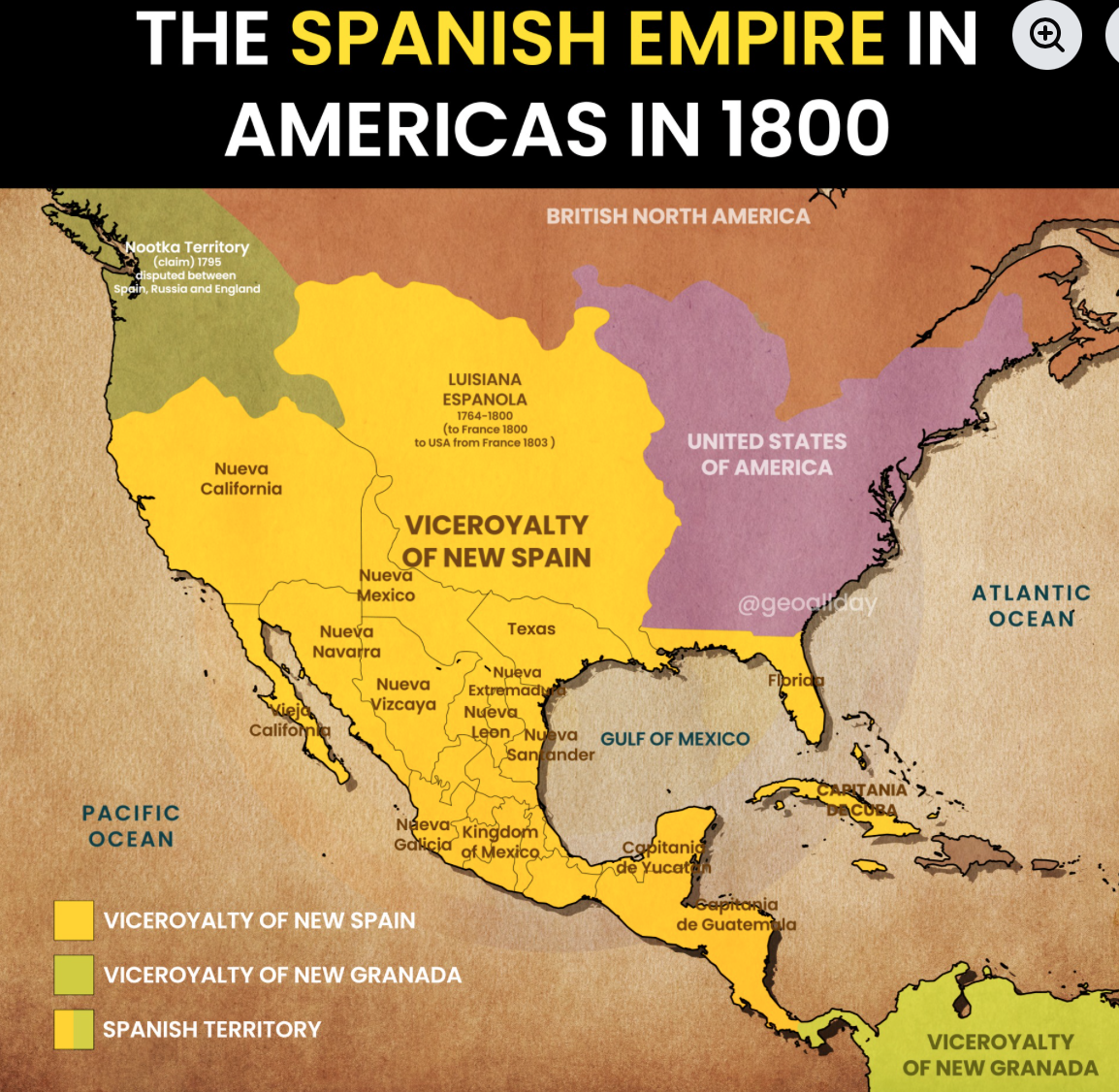
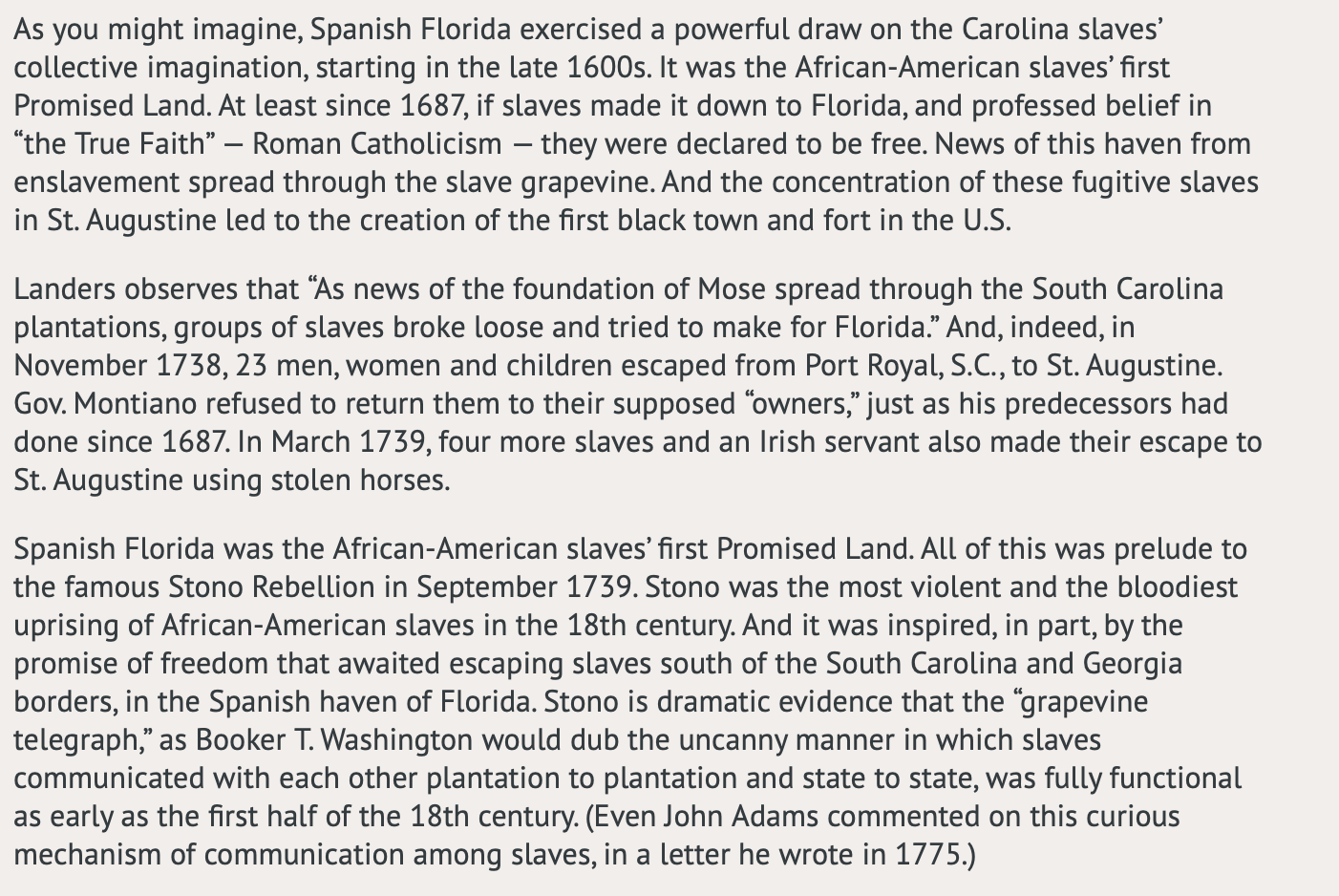
In 1693, King Charles II of Spain issued a royal decree. It offered freedom to runaway slaves who converted to Catholicism. They also had to serve the Spanish Crown. This evolved into a formal fugitive slave policy, which would later become significant in Florida’s history. Many enslaved Africans escaped from the Carolinas. They sought refuge in Spanish Florida. After four years of service, they were granted freedom. By 1738, Governor Manuel de Montiano established Fort Mose, the first legally recognized free African settlement in North America.
Fort Mose was led by Francisco Menéndez. He was a former enslaved African and a veteran of the 1715 Yamasee Wars. The fort was home to thirty-eight men and their families, totaling about one hundred people. When the British attacked in 1740, the community temporarily abandoned the fort. After regaining it through a successful surprise attack, the fort was destroyed, but it was later rebuilt in 1752. When Florida was transferred to British rule in 1763, these African settlers left for Cuba with the Spanish forces.
I also watched a documentary called The African Americans: Many Rivers to Cross. It covered The Black Atlantic 1500-1800 timeline episode. Excellent black American perspective.
St. Augustine and the First Thanksgiving
St. Augustine is the oldest city in the United States. It is also the site of what is considered the first Thanksgiving celebration. This event was held in 1565 by Pedro Menéndez de Avilés and his crew. After safely arriving in Florida, Menéndez held a mass to thank God for their survival. He then shared a celebratory meal with the local Timucua tribe. This marked the first recorded gathering of European settlers and Native Americans sharing a meal. This occurred long before the more widely recognized Thanksgiving in 1621. That event involved the Pilgrims and Native Americans in Plymouth.
A Second Filipino Landing in America
The first recorded landing of Filipinos in what is now the United States occurred on October 18, 1587. A century later, in 1687, a group of fugitive slaves from the Carolinas arrived in St. Augustine, seeking freedom. Governor Diego de Quiroga reported to Spain about the escape of eight men, two women, and a child by boat. They were put to work on the Castillo de San Marcos or as domestic servants. These individuals were paid for their labor, marking a stark contrast to the treatment of slaves in the English colonies.
The institution of slavery in Spain differed from other European powers. It was governed by ancient Roman traditions. These were codified in the thirteenth-century Castilian law known as the Siete Partidas. This legal framework granted enslaved people certain rights. It outlined paths to freedom. This reflects Spain’s Catholic influence, which viewed slavery as an unnatural condition. Masters and the Church were expected to teach enslaved people the faith. This education allowed them to be admitted into the Church and its sacraments, including marriage. Families were to be kept together, and owners often formed kinship ties with enslaved people through the Church.
The Spanish mission system spread across the Americas. It was designed to Christianize Native Americans. Its goal was also to expand the reach of the Catholic Church. Free and enslaved Africans participated in Spanish expeditions to the New World. These expeditions further intertwined the Spanish colonial system with both Native and African populations.
In 1537, Pope Paul III issued the papal bull Sublimus Dei. It prohibited the enslavement of indigenous peoples of the Americas. It also affirmed their right to freedom and the sacraments. This decree was significant in shaping Spain’s approach to slavery in the Americas. However, it did not end the enslavement of Africans. They continued to be captured in wars and sold into slavery across the Atlantic.
The End of Spanish Rule and U.S. Control
By 1898, the United States took control of former Spanish colonies after the Spanish-American War. Cuba was granted its independence. However, Afro-Cubans remained free under Spanish rule. In contrast, the Philippines, another former Spanish colony, did not gain independence until 1946. Despite the irony of U.S. claims of liberation, many territories remained under U.S. control long after Spain had granted freedom to its former colonies. The Philippines came under US benign assimilation under the Commonwealth started in 1935. Test end
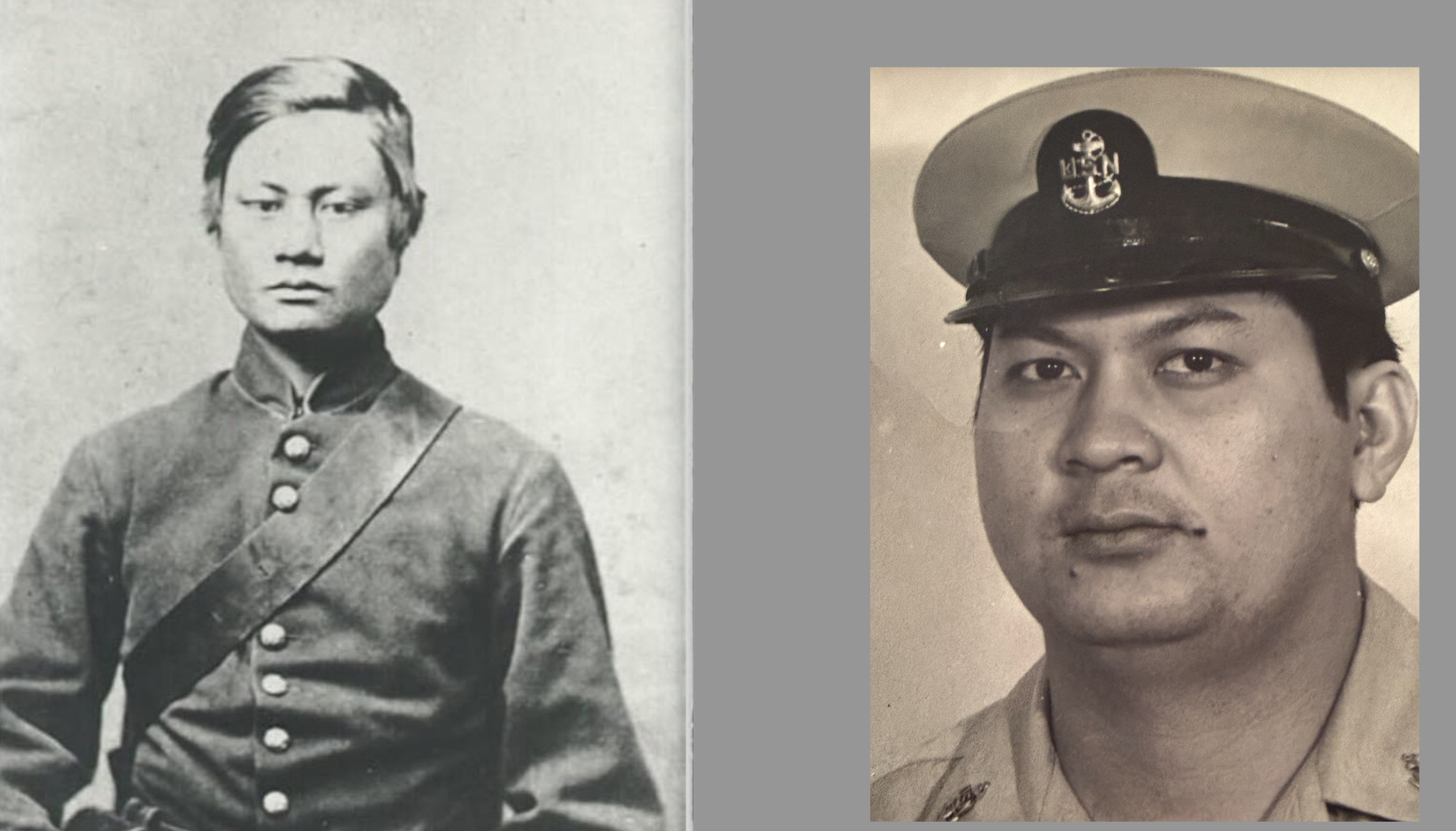
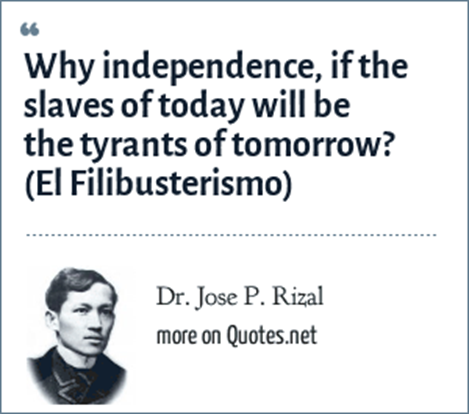
The downfall of the Spanish empire marked the beginning of the first American century. Filipinos started a new era that the world had never known. They were a young nation. They were strong conquerors with no intention of occupying nations. Their only aim was to secure a piece of land to bury their dead soldiers and sailors. This was an unprecedented move in history. The American empire fought the two great World Wars. Philippines and Puerto Rico the only exceptions, under the benign assimilation supposed in their own image that never work. Rizal knew that today’s slaves would become tomorrow’s tyrants. The United States of America, the country without a name, is a beacon of light. It allows the world to live on their own, equal but not separate. We are all immigrants except be an American. In the 1850’s US Civil War breaks out, testing that all men are created equal. The war only forbid the nation breaking away nand United States keeps its nation for another 250 years. Filipinos served in this ward. The most prolific is Felix Balderry. In his amazing bio, it is mentioned that he has a son Frank. Frank became a medical researcher and practices the profession in Arizona. Bothe were buried in Kalamazoo, Michigan. The birthplace of the 1920’s viral therapy, that Dr Frank Balderry himself were among the pioneers. Where Frank treated his dad of Tuberculosis Dr Jose Rizal treated his mother blinding disease.
The world now lives in the quincentennial. It is the 250th birthday of the American empire. The second centennial has arrived still without additional territory. American even help the Cremona Pinenzula at the darkest moment of the US Civil War. The so-called enemy learns to engage in any war. Pick the American way and either way you win. This is a lesson from Lawrence of Arabia. It is also seen in the US Land Lease redemption to Russia among others.
You can call me an American stoulle and paupet. I serve in the United States Armed Forces proudly in both war and peace.
Private Balderry, Union Soldier from the Philippines. Chief Nestor Palugod Enriquez USN 198-1978
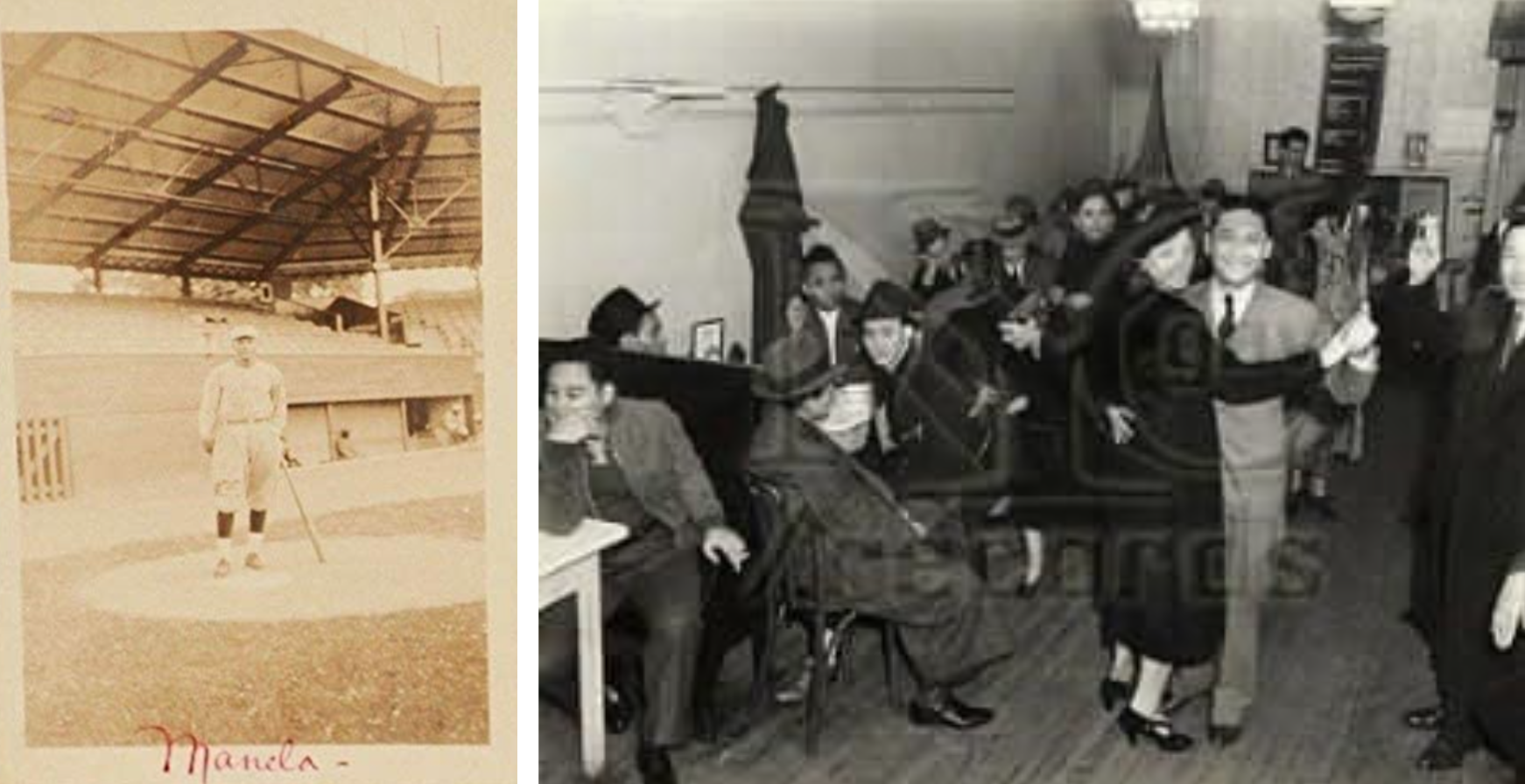
Claudio Manela was the first minor league baseball player from the Philippines. He was working on a Filipino steamship when he left to settle as a musician in New York. He signed with the Cincinnati Cuban Stars in 1921, going 4-10 with a 4.00 ERA. Technically, he was the first Filipino in the Negro Leagues. In 2020, MLB took the step to recognize 100+ year old Negro League stats retroactively to acknowlege the contribution of Black Americans to the great American pastime.
The WPA, a federal government agency, allows free use of their photos, at least for noncommercial use. This is a rare photo for Filipino American history as the first Filipino American residence and restaurant in New York. Claudio lived here for years, and I like to imagine that Claudio is the Filipino dancing in this photo.
Let’s look at over 100 years ago, during the days of our Manong. He filled out a World War II draft card, with a birthdate of April 12, 1893, showing him living in Newark, New Jersey. He appears several times as a crew member on ship manifests from 1946 to 1948. Claudio Manela played baseball before the great Jackie Robinson broke the color line and became the first African American to play in Major League Baseball for the Brooklyn Dodgers on April 15, 1947.
Both Robinson and Manela played on the same team in Jersey City at Roosevelt Stadium around 1921. Claudio started baseball in the semi-pro colored league even before the great pitcher Satchel Paige. He also appears in the Social Security Death Index, still residing at the time of his death in November 1975 in Newark.
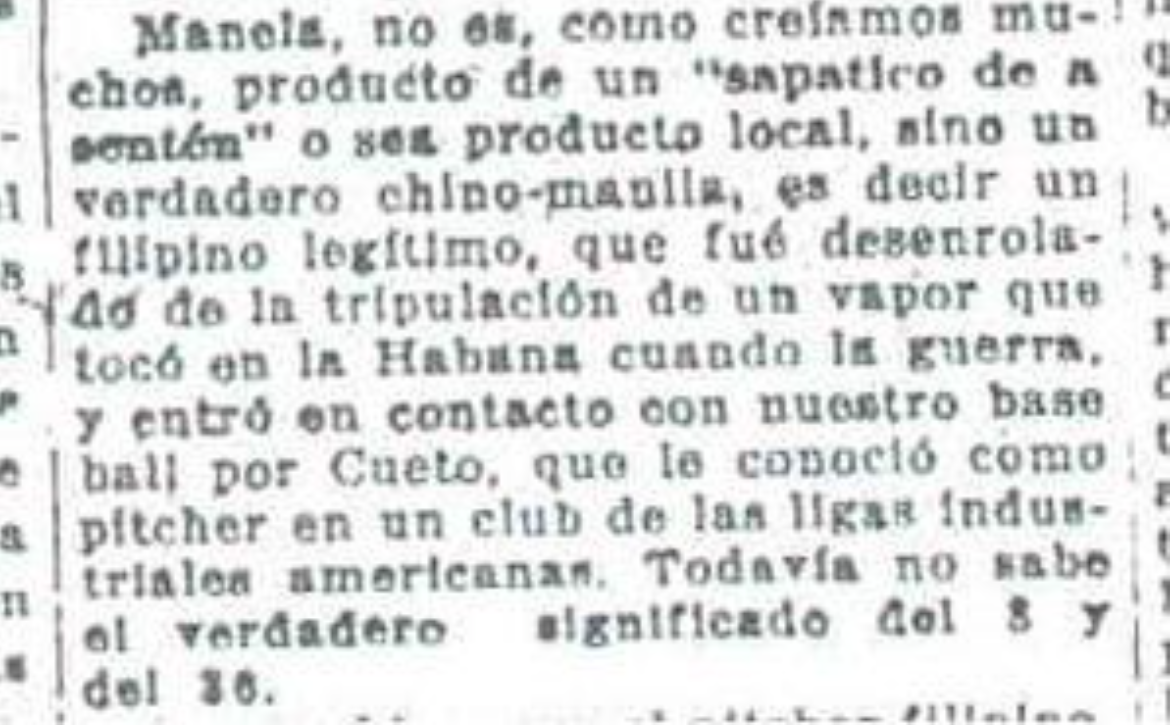
The 1921 Cincinnati Cuban Stars had Claudio Manela in 1921-22, a Filipino lefty who lived in Brooklyn in the late 1910s and early 1920s. This is the headline from Diario de la Marina that confirmed it (October 27, 1921).
“Manela is not, as we had thought, a product of a ‘sapatico de asentén’ [?] or a local product, but is instead a true ‘Chino-Manila’, that is to say, a legitimate Filipino, who left the crew of a steamship that called at Havana during the war, and was brought into contact with our baseball by Cueto, who had known him as a pitcher for a club in the American industrial leagues.”
…Claudio Manela thus joins a rather select company of professional Filipino ballplayers to have come to the United States; to my knowledge, Manela was, I think, the only Filipino to play in the Negro Leagues.“
It turns out that there was a dispute over the drafting rights to Manela between Hartford and Jersey City of the International League. The Hartford Senators were assured the services of the swarthy heaver when he was notified by Secretary Farrell that Jersey City disputed the property of the pitcher, who ruled the Cuban belonged to the Senators. (Courant 3/29/1922)
Lou Gehrig signed a contract with the Yankees on April 30. Gehrig returned to the minor-league Hartford Senators to play parts of two seasons, 1923 and 1924, the same year when Claudio, Gehrig joined the Yankee major team, indeed, the luckiest man alive.
Manela’s grave can be found at the Bloomfield Cemetery NJ. 75 years later, Bobby Chouinard became the second Filipino baseball player. Chouinard was listed as the first until the Negro Leagues were given major league status in 2020. He was briefly with the Hartford Senators in 1922. In 1925, he allowed nine hits and nine runs (five earned) in 4 2/3 IP for the Cuban Stars.
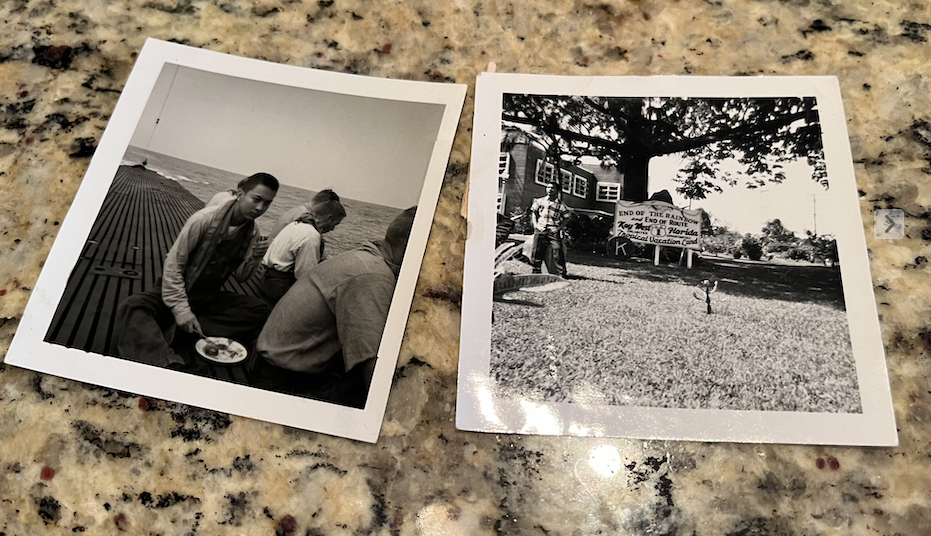
I recently watched Amazon’s remake of the 1980s movie “Roadhouse,” and it instantly brought back memories of my early submarine life. Unlike the original, the new movie is set in the Florida Keys, where I was first stationed as a young sailor. Within 4 years, I crossed paths with astronaut John Glenn, President John F. Kennedy, and the boxer Muhammad Ali.
As I wasn’t yet of drinking age, I didn’t get to share a Cuba Libre with Hemingway at his regular Key West drinking hole, the Brown Derby Saloon. The bar in Roadhouse, however, was a steel cage of sorts, home to lots of manly brawls. My steel cage at the time was a claustrophobic diesel submarine, where I was a crew member.
In the era of transition to Nuclear power, in 1958 the USS Nautilus went under the North Pole the year I joined the US Navy. Harnessing the power of nuclear reactors to produce unlimited energy, as opposed to putting wild gladiators inside a steel cage and fighting to the end. It started when the power of the wind was harvested.
I once was in a Charleston shipyard, stopping to charge the submarine’s battery. There I saw Roman Gabriel featured in an issue of Sports Illustrated, who was playing football for NC State. Following sports was a way to assimilate into American life. From there, we sailed to Europe for three months. We got to see the 1960 Olympics in Rome and watched Muhammad Ali.
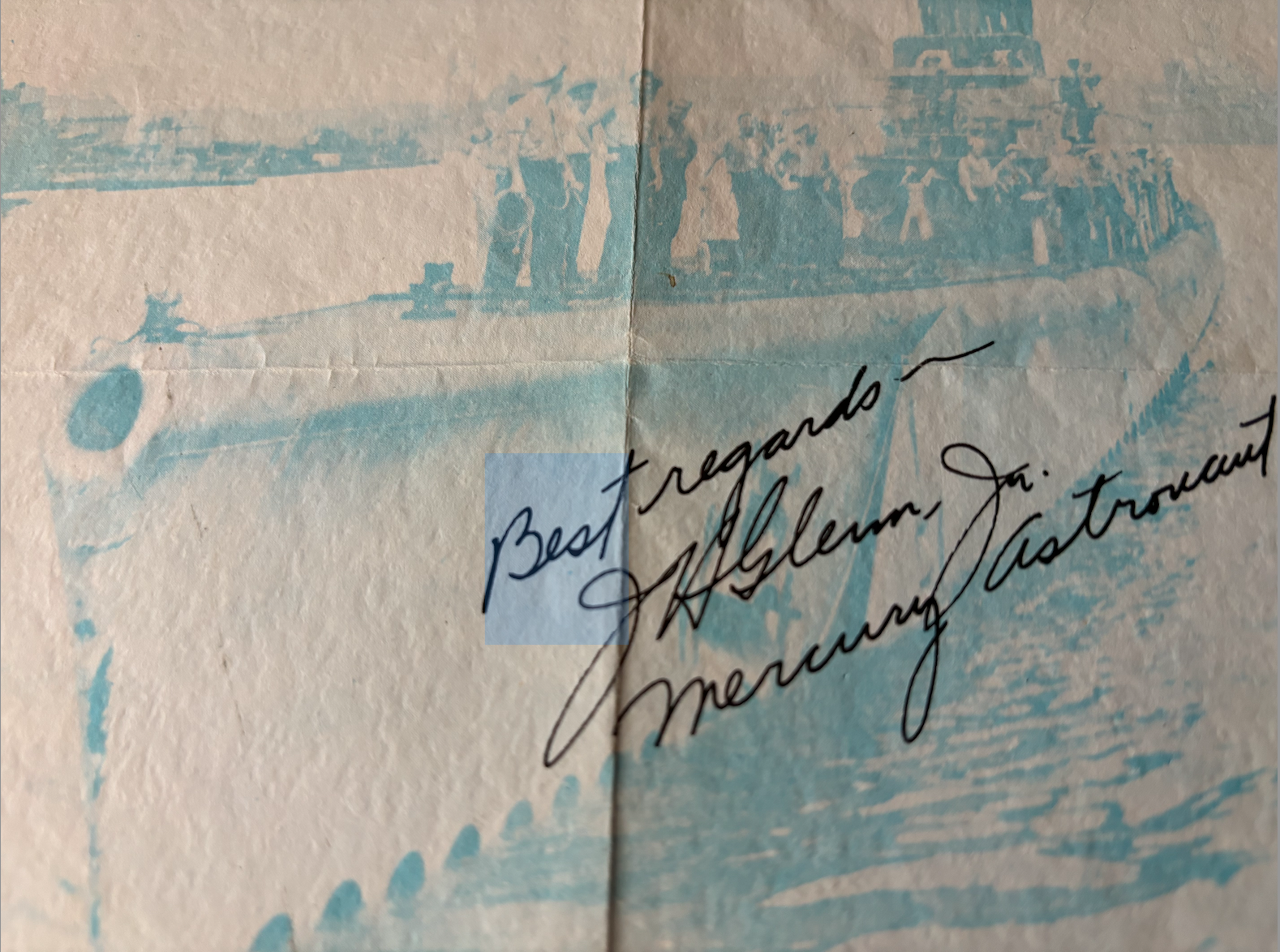
My limited Spanish translation skills helped a few asylum seekers who were pulled onboard trying to escape the crisis in Cuba. We visited Gitmo 4 times in those years. In 1961, we met up with John Glenn who was in medical isolation after a preparatory voyage for their moon landing. We also met up with JFK, in that infamous October of 1962, as Key West was the ground zero for the Cuban Missile Crisis.
My last tour was at Charleston Submarine Base, assigned to Fleet Ballistic Missile. Simply put capable of mass destruction. My lowly office and sleeping quarters were sandwiched by a nuclear reactor and 16 ballistic missiles armed with warheads. It was my version of sleeping with the devil. Our world was lucky we never fired in anger, a true deterrent of peace. The photo of me is undersea, believe it or not near Disney World. I brought my family here for the last reminiscent six years later.
The one-liner “Nobody wins in a fight” is an important lesson. The Greyhound station is a fixture in the movie as well, reminding me of my last day in the Keys, where I boarded a bus to start a journey back to the West Coast. Needless to say, I never became “Ernestor” Hemingway, my wild fantasy. I’m just the Old Man in the Sea, as Ernesto would say with humility. I was just a passenger among the crazy bunch of men. I am proud but no hero.
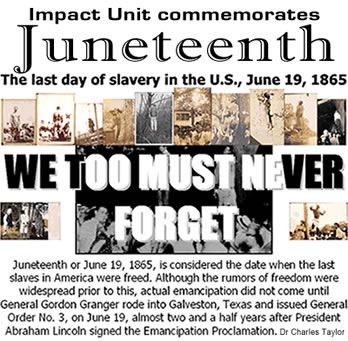
Juneteenth is now a Federal Holiday this year. Juneteenth is a celebration of black history and freedom, a holiday relatively few Americans had heard of until recently, if at all.
Suddenly, Juneteenth is prominent on the nation’s calendar, propelled by wide protests against racial injustice. The holiday gets its name from June 19, 1865. That’s the day the Union army arrived in Galveston, Texas, to announce that all African-American slaves in the state were free under President Abraham Lincoln’s Emancipation Proclamation. The state was the last in the Confederacy to receive word that the Civil War was over and that slavery had been abolished and the last where the federal Army established its authority.
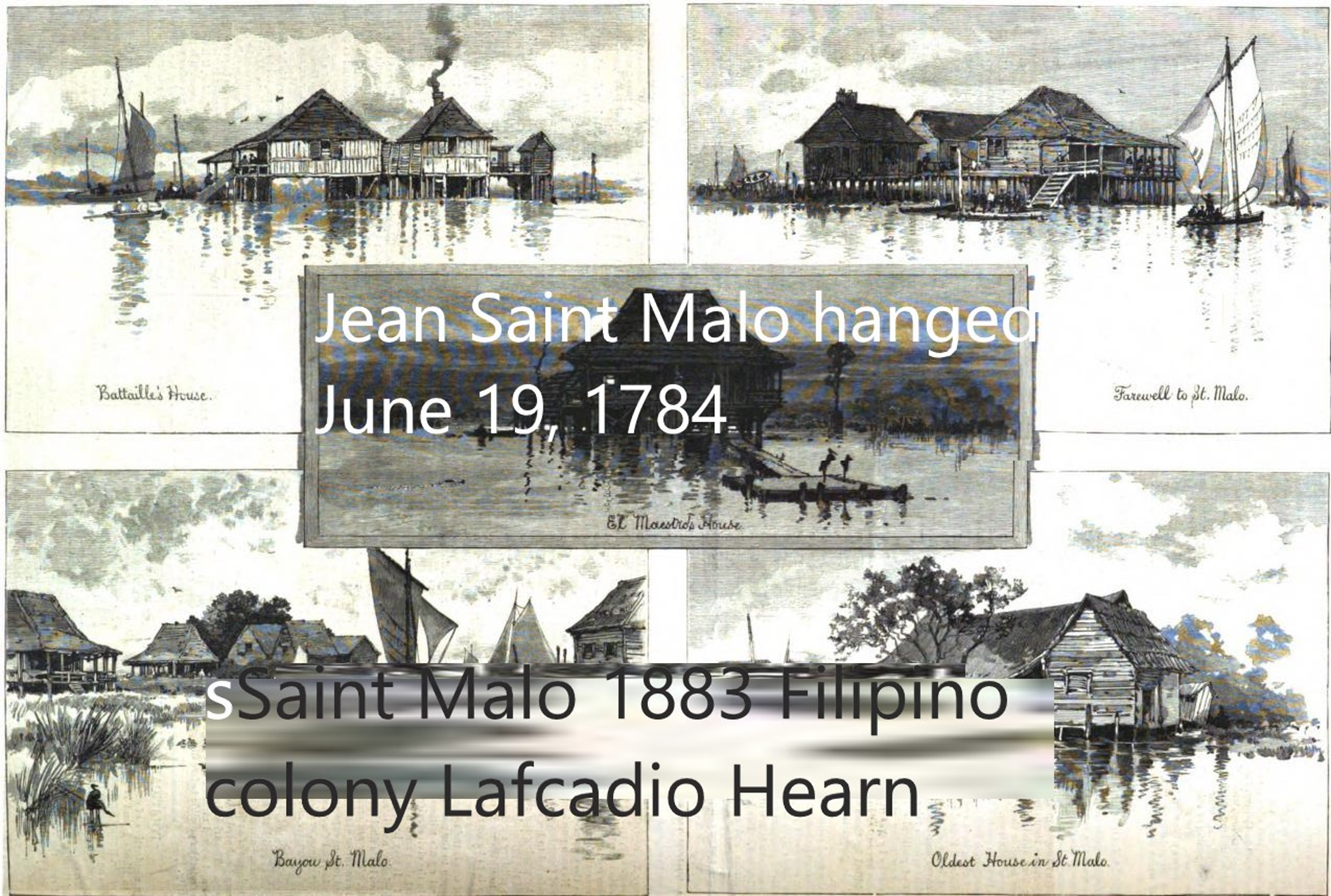
My comparative weaving timeline is farfetched perhaps, but that’s the way I see and write. A Filipino settlement in Saint-Malo in the early 1800s is documented by Lafcadio Hearn’s article in Harper’s Weekly. I bought all the surviving issues that I could find. Hearn was described as a macabre writer, and I will add that he, too, fought against early discrimination and inequality.
In the early 1780s, Jean (also known as Juan and his colony of runaway African slaves) invaded the dense swamps east of the city and across Lake Borgne. They obtained weapons from free blacks and fought for their freedom. Jean thrust an ax into a tree and declared, “Woe to the White who would pass this boundary.” The rebels escaped to Saint-Malo Bayou. The Spanish colonial authorities led a campaign to suppress slave revolts, capturing what will be known as Juan Saint-Malo and his 60 followers. He was condemned to death by hanging, on the charges of murder. The execution was carried out by the alcalde Mario de Reggio on June 19, 1784, in front of St. Louis Cathedral at the present-day Jackson Square in New Orleans. I always assumed that our Saint Malo was named for the France region during the French reign in the Mississippi River. New Orleans had another legendary Jean of Saint-Malo during the Jackson era of the War of Independence. Half pirate and trader, Jean Lafitte is rumored to be from Saint-Malo.
The greatest French explorer is Jacques Cartier born in 1491 in Saint-Malo, the port on the north-east coast of Brittany. Commissioned to “discover certain islands and lands where it is said that a great quantity of gold and other precious things are to be found”. But instead, he claimed Canada for the French king. One of the expeditions took off from Saint-Malo and a Canadian place got its name Saint-Malo. Failing to find the westward passage to the Orient, the explorers followed the great Mississippi ending to the Bayou du Saint-Malo.
On June 19, 1861, Dr. Jose Rizal was born in the Philippines and the beginning of the US Civil War. The Filipinos were mostly seafarers when they participated in the conflict. A few even served on the newest warships at the time, the Ironclads and the Union ship Monitor. Combined with its rotating turret, the world got a naval revolution in construction.
The Union victory brought us Juneteenth of June 19, 1865, but was never as prominent as the expected 2020 celebration as it gets a new meaning.
June 19, 2020, was Rizal’s 159th birthday celebration as we are still learning his words. Why independence? Of the slaves of today will be the tyrants of tomorrow. Interestingly even the US Navy named a warship USS Rizal in the 1920s. Maybe I could have found the meaning of Saint-Malo by having a sumptuous feast at Saint Malo restaurant in the nation’s capital, ordering from their fusion menu. The restaurant however is gone, a casualty of Covid19. It is not Saint Malo the bad saint as there was never one but my halo-halo Filipino American history continues.
I spent more time in Charleston than under the Atlantic Ocean, so this observation is more than a limited periscope view. This historic town is well preserved, classic as Gone With the Wind. Fort Sumter faces the Battery Park, but in the heart is the Market Place, where the only surviving building is about human exchange.
Now a museum, it is the slave auction gallery where the black slaves were auctioned fresh from the port more than hundred years ago. It is estimated that over a third of African slaves came through the port of Charleston.
The main street is King Street, where the City Library provided good reading; mostly the sports pages about Roman Gabriel. The street parallels Meeting street and both run to North, toward the Charleston Navy Shipyard. I drove down it many times, crossing the railroad track, near Calhoun Street where the racist Dylann Rowe shot the church goers. The rail crosses King and Meeting street. The great divide, the proverbial saying “born in the wrong side of the tracks.” North of the line was the dodgy slum were the black community lived. Farther north, the Navy Liberty town, Reynold street, drunk sailors would strolled every night from bars and taverns catering to the Navy Main gate. I was there when racial segregation manifested into the anti-miscegenation laws. Filipino sailors could not marry whites, or even shack up with one. Live together in a trailer and you will get a visit from the vice squad. I found it interesting that some Filipinos would go to North Carolina to marry their white girls, since they had different anti-miscegenation law for Filipinos after WWII. It might be the loophole that the father of Roman Gabriel found. He married an Irish girl and settled in Wilmington, NC where Roman grew up and became All-American.
The H.L. Hunley was a Confederate submarine that played a minor role in the US Civil War, but she demonstrated the advantages and the dangers of undersea warfare. She was sunk in Charleston harbor where she remains. After I left the submarine force, Hunley was salvaged. It is now on display on the north of Charleston not as Confederate triumph, but She was the first combat to sink a warship that change naval warfare. As segregation law changes, for some the culture might remain. I was surprised when I met an African American. When he told me that he graduated from Citadel, I immediately asked if he was the first black cadet. The Lilly-white military school in Charleston was the West Point of the South. I remember the Cadets; they were all white; I hate it most for they had the great advantage in pursuing the southern lass 😉
Charleston is city of Rivers, it fuels the economy around it. Southern politics learned after reconstruction to send the same representative to bring home porky bacon. Mindel Rivers became one of the most powerful men in Washington. He was re-elected multiple times, eventually gaining the chairman of the Armed Forces appropriation. Nuclear submarine flotilla turned the city into a military-industrial complex. The Southern Democrat Party that once controlled the house now had their fortunes reversed. Mindel Rivers had the makings of the perpetual drunken sailor, friend of the military, but an ardent segregationist of his time.
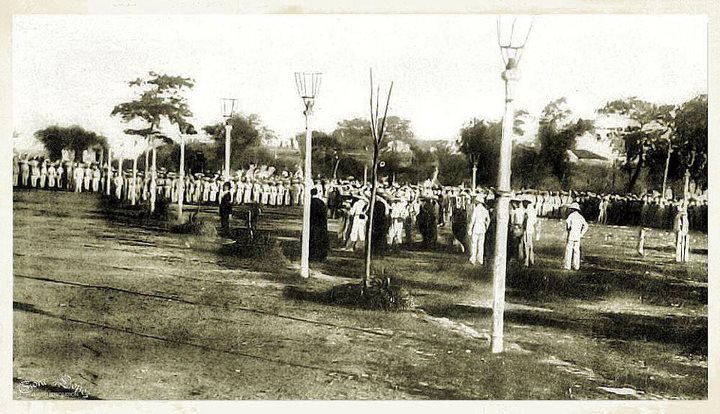
Focus on the sitting dog in the middle of the picture of the December 30, 1896 execution. An eye ball account from a 20 year old witness, “Suddenly, as if from nowhere, a small dog appeared and ran in circles around Rizal’s fallen body, barking and whimpering. (This incident would much later be the subject of our talk in our quarters. To some of my comrades, it was an omen of a coming misfortune.)”
This is more than interesting trivia to me. The unleashed dog awakens the sleeping Filipino nation. barking and brewing the historical revolution in the cradle. Hilarion Martinez’s narration was published in the Sunday Times Magazine on December 25, 1949 when he was already 72 years old.
Another enhanced version:
“Then suddenly, as if if from nowhere, a small dog appeared and ran in circles around the body of Rizal, barking and whimpering. The Capitan Militar de Sanidad, or medical officer, knelt before the fallen man, and felt his pulse. Looking up, the medical officer beckoned a member of the firing squad to come forward and give the body the ‘tiro de gracia’: a shot done at close range. I thought I saw a faint haze rise from Rizal’s coat, but it might have been a wisp of morning mist. Seeing the body before me, I felt faint. I wanted to see the face of the man for the last time. Rizal lay dead on the dewy grass. The day had started and little- did I realise that I was gazing on the face of the greatest malayan of them all, that I was witnessing history in the making.”
“When I saw him. I know he was Jose Rizal. He was of regular built, unshaven and quite pale perhaps on account of his confinement, but was visibly composed and serene. Amidst the silence, Rizal began to move his head very slowly up and down, his lips moving as if in prayer. Then the commanding officer, by means of means of a saber, signalled the firing squad to aim. The saber dropped and there was a simultaneous crackle of rifle-fire. Jose Rizal wheeled in one last effort and toppled forward with a thud;his face turned toward the sky and his derby hat thrown forward. He fell facing the bay.”
What exactly immediately happened with the body of Rizal that day reminded me of José Martí (1853-1895), the Cuban patriot. Just one year earlier,May 19, 1896, he was killed in the battle against Spanish troops at the Battle of Dos Ríos, The Spanish took possession of the body, buried it close by, then exhumed the body upon realization of its omen. They are said not to have burned him because they were scared that the ashes would get into their throats and asphyxiate them. He is buried in Cementerio Santa Efigenia in Santiago de Cuba. Many have argued that Maceo and others had always spurned Martí for never participating in combat, which may have compelled Martí to that ill-fated suicidal two-man charge. Some of his Versos sencillos bore premonition: “No me entierren en lo oscuro/ A morir como un traidor/ Yo soy bueno y como bueno/ Moriré de cara al sol.” (“Do not bury me in darkness / to die like a traitor / I am good, and as a good man / I will die facing the sun.”) Maybe the two Masons compared notes on May 1888 when the two were in Manhattan.
Hilarion Martinez’s complete account at the age of 72 of Bagumbayan Field:
“It was six o’clock in the morning of December 30, 1896, when we woke up at our quarters at the corner of Sta. Potenciana and Magallanes Streets, in Intramuros, to attend the execution of Jose Rizal, about which we had already been briefed the day before. We were theLeales Voluntarios de Manila, a semi-military organization under the command of Capt. Manuel Leaño. Our immediate officer was a youthful Spanish lieutenant named Juan Pereira. I was twenty years old then, and a member of the drum corps.
We marched out of Intramuros through the Puerta Real, or where Nozaleda (now General Luna) Street out through the walls on the south, clad in our camamo uniforms and with our cajas vivas(or drums) strapped around our waists. We proceeded to what is now Padre Burgos Street, under an overcast sky and in a chilling December morn.
As we rounded the corner of P. Burgos and General Luna Streets, we got a glimpse of thecuadro, a square formation of about ten companies of Filipino and Spanish soldiers. The former occupied the inner portion of the quadrangle, while the latter were at the rear. This formation was strategic because the Filipino soldiers’ position with-in the cuadros ignified that the Spanish authorities wanted Rizal to die in the hands of the Filipino soldiers. If the latter disobeyed the command to fire upon Rizal, the Spanish soldiers positioned at the rear would fire upon them.
There were civilian spectators, too. The side of the cuadronear the bay was open.
As we approached the quadrangle, we saw some Spanish military officers earnestly talking in low voices. Rizal was not yet anywhere to be seen. Not having had a glimpse of the man before, I began to wonder what he looked like. I remembered what my mother had told me about Rizal: that he was so learned that he could not be poisoned by anybody because he always carried with him his own spoon and fork, by means whereof he could detect whether his food was poisoned or not; that many other legends had started to be woven around him; and that he was fighting for the cause of his country and countrymen.
Soon the small crowd heard the muffle sound of our approaching vivas(or drums) draped with black cloth during execution ceremonies. A slight commotion broke out at the right end of the cuadronear the bay as some soldiers with fixed bayonets entered, followed by a man in black suit, his elbows tied from the back, on his head achistera(or black derby hat), on one side a Spanish officer and on the other a Jesuit priest.
When I saw the man, I knew he was Rizal.
A group of Spanish officers who were standing nearby opened into amedia luna(i.e., a semicircular formation). Then a Spaniard (we would learn later he was Lt. Luis Andrade, one of Rizal’s popular Spanish defenders and sympathizers) affectionately shook the latter’s hand. When Rizal was near the center of the quadrangle, themayor de la plaza, a colonel, announced at the bandillo:‘En el nombre del Rey, el que se levante la voz a favor del reo sera ejecutado’(In the name of the King, he who raises his voice in fovor of the criminal will be executed).
A deep silence enshrouded the whole assembly.
The commanding officer accosted us and gave us this injunction: ‘Should Rizal attempt to speak aloud, beat your drums so hard as to drown his voice’.
I looked at Rizal. He was regularly built, unshaven, and quite pale, perhaps as a result of his detention. But he was visibly composed and serene. A Jesuit priest approached him, prayed, and blessed him.
Then a colonel approached Rizal likewise, as the commanding officer ordered us to move two paces backwards. The firing squad, composed of six Filipinos, came forward and took our former position behind Rizal.
I saw Rizal exert effort to raise his right hand, which was tied at the elbow, and take off his chistera.” (the darby hat)
My heart beat fast, and as in all other executions I had witnessed before, I felt tense and nervous. Amid the silence, I saw Rizal move his head very slowly up and down, his lips moving as if he was praying.
Then the commanding officer raised his saber – a signal for the firing squad to aim. Then he dropped his saber to a fuego position. The simultaneous crack of rifle-fire shattered the stillness of the morning. Jose Rizal exerted one last effort to face his executioners and toppled down with a thud, his face towards the sky and his derby hat thrown ahead. He fell dead at his feet in the direction of the bay.
Many of the reos or offenders had been caused to kneel and be hoodwinked before they were shot on the head. But Rizal was spared that humiliation.
Suddenly, as if from nowhere, a small dog appeared and ran in circles around Rizal’s fallen body, barking and whimpering. (This incident would much later be the subject of our talk in our quarters. To some of my comrades, it was an omen of a coming misfortune.)
Then the capitan militar de la sanidad (i.e., medical officer) stepped forward, knelt before the fallen man, and felt his pulse. Looking up, he beckoned to a member of the firing squad to come forward and give the final tiro de gracia (i.e., another close-range shot to the heart), probably to ensure that Rizal could not come up with the miracle of life anymore. I thought I saw a faint haze from Rizal’s coat, but it might have been a wisp of morning mist. Seeing the body of the fallen Rizal in front of me, I felt very weak.
The officers began to show animation again. They fell in formation and marched to the tune of the Spanish national air, the paso doble Marcha de Cadiz.
As in previous executions, we members of the drum corps filed past the body to view it for the last time. When I heard to command “Eyes left”, I did not shut my eyes as I had done at the sight of the several roes whose heads were blown off by rifle-fire. I really wanted to take a close look at the man one last time. He lay dead on the dewy grass. The day had already progressed, and little did I realize then that I was gazing at the face of the greatest Malayan, and that I was witnessing history of in making.”
Hilarion Martinez was, indeed, lucky to have lived in historic times. He subsequently joined the Philippine Revolution. During the Filipino-American War, he was a member of the “Batallon de Manila” under General Pantaleon Garcia and Col. Rosendo Simon. He distinguished himself in several engagements, so that he was promoted later to the rank of 2nd Lieutenant. In an assault on the American cavalry stationed in the church of Tondo, he was captured and imprisoned for about eight months in Intramuros and later in Cavite, where he was released shortly after the cessation of hostilities.
This nation is celebrating the bicentennial of the War of 1812 – the war that inspired the Star Spangled Banner and echoed the climatic volley of cannon fire and ringing chimes, the 1812 Overture. The US was a young boot nation on a protracted revolution matching up against the daunting British Royal Navy, the most powerful sea power of the era. But, equally daunting is to have a Filipino serving in the War of 1812.
The decisive battle of New Orleans actually happened in the swampy St Bernard parish. A large British fleet had anchored in the Gulf of Mexico to the east of Lake Pontchartrain and Lake Borne. Defending the US was a ragtag military of slaves, free black militia, creoles, Choctaw Indians and band of pirates and sailors. A separate legend would be passed on among the various ethnic lines. One the stories of Filipinos fighting against the British invasion were about the early Filipino strugglers from St.Bernard Parish.
This would remain apocryphal until Agustin Feliciano came to my radar. Over a hundred years ago, a Filipino student magazine based in Washington DC received a strange letter from New Orleans. “The Largest Colony of Filipinos in America”, The Filipino, March 1906, pp.19-20.
“We received a subscription from a Filipino living in New Orleans, and as we did not know there were any Filipinos in the southern part of this country, we were very much surprised, and wrote to him, asking that he send us some details concerning himself and any other Filipinos that there might be in his neighborhood. The Filipino whom we addressed was Mr. Eulogio Yatar, and he sent us some most astonishing news; in fact, we feel almost as the ethnologist does who discovers a new race of people, for we find that there is a colony of 2,000 Filipinos in that Queen City in the South.”
This community had been established for about a hundred years; the first one who landed there being a Bikol by the name of Augustin Feliciano, who later served in the American navy in the war of 1812.
Filipino sailors landing in New Orleans can be traced as far as 1763, but we are only all familiar with Filipe Mardriaga and the Burtanog Sisters. Felipe married an Irish girl, Bridgette Nugent. One of their three daughters Elizabeth, born in June 1857, married Valeriano Baltic Borabod. This couple’s second daughter, Othelia Lilian Borabod, was born on Jan 7, 1881. Eulogio L Yatar was born on Dec 7 1877 in Malinao, Capiz and moved to New Orleans where he married Othelia. Rhonda Fox,a 6th generation of the Madriaga family and now the mantle of historian connected us to Eulogio Yatar, died on 1928 and was buried at the Yatar Family Crypt, St Vincent Cemetery No.2.
The War of 1812 is more than the classic overtone, it is the rise of the United States Navy around the world. It inspired Teddy Roosevelt’s Naval War of 1812 and changed the course of history, he was probably thinking about Manila Bay already. Alex Fabros calls Agustin Feliciano, the first Filipino in the US Navy. On the lull of the thundering 1812 overtones, we can hear the name of Agustin Feliciano, the Bicolano in the bayous of this bicentennial year.
Navy Liberty in the French Riviera is among the best I have experienced. I remember going there when Cannes was still unknown, nor the place called Villefrance, after DeGaulle pulled out of NATO because of France’s love and hate against the United States. One summertime, I looked up the periscope from Gulf Juan, scanning the beach and my usual taking Liberty with our hero and the French Connection and the love songs of Whitney Houston. Elevating the Periscope I can see the train running on the mountain side and rewinding back my memory, many summers ago.
On July 1, 1887, Rizal rode the train along the French Riviera from his Italian journey and was treated with much amiability by an American couple who invited him several times to dine and drink with them
They brought fruits for Rizal before saying good bye in Monaco. “. . . aboard the train from Marseilles; he (Rizal) swears he will never forget the American couple on the Euro rail to Monaco. The man, a banker, was nondescript’ but his wife had blue eyes and ‘ a smile as chaste as a Christian virgin’s’. One thing he had not lost was his eye for the girls. As Leon Guerero (First Filipino) would later write:
“We shall hardly see each other again,” Rizal said when they parted.
“Who knows?” the Christian virgin replied. “I should certainly hope so.”
“I am in the hands of fate.”
“Really? I believe it, “she said, and waved to him as the train pulled out.
Rizal was never lost in the words of Shakespeare, but he was merely smitten in brief passing fascination. He was on his way home to the Philippines to his childhood sweet heart, Leonor Rivera the real life Maria Clara of his novel but more of Shakespeare ‘s Romeo and Juliet tragedy . She prevented Rizal from falling in love with strangers in his travels. Rizal was coming home to reclaim the love of his life.
Unfortunately, the affair was doomed in the very beginning. He was boarding in his uncle’s house in Intramuros just starting college, when he met just the 11 years old Eleonor. She was a “pretty woman with a high forehead, soft and wavy hair, almond eyes, small and pensive mouth, and engaging dimples. She was described as a talented, mature, and intelligent lady. She played harp and piano and had a charming voice. She could write and read Spanish. The puppy love blossomed into secret love letters written in different languages including English. Hidden communications because Leonor’s mother was against Leonor pen pal lover. Friendly spies of Rizal informed of her activities from Camiling to Dagupan. They were also distant cousins.
Rizal went back to Manila via Suez Canal on August 3, 1887. He tried visiting Leonor; but his parents did not allow him to go to Dagupan. By then travel to Dagupan was on the fast track, but without a word of anger or even a protest, he bowed his head and said, “Very well, father, I will not go.”
A year later, Rizal, the fugitive his country, was on his way to America. The American lady in Marseilles closer, but just distant memories on his long railroad travel from San Francisco to New York.
Leonor immortalized in Noli Me Tangere made Rizal the subversive in the eyes of Spanish authority. The mother fearing safety succeeded in convincing her daughter to forget the young Bohemian rebel. Some wrote that the mother even persuaded Eleonor that Rizal was only interested in Dr Blumentritt daughter. Leonor was forced to marry Henry Kipping, an English engineer working on the Manila railroad to Dagupan. She agreed and she would never sing again for her mother. The engagement broke Rizal heart on the chugging sound of locomotion, the pair of a long iron tracks always abreast, reaching final station would never touch. The greatest love was on the wrong track, Noli Me Tangere always on an arm’s length.
Rizal wrote to his friend Blumentritt, “The first hammer-blow in the railway has fallen on me!”
He had political explanation; “I do not blame her for preferring Kipping..an Englishman is a free man, and I am not.”
A year later, Rizal, the fugitive his country, was on his way to America in 1888. The American lady in Marseilles just distant memories on his long railroad travel from San Francisco to New York. He saw the beautiful statue in the harbor, the gifted Lady Liberty from France. The lady became the symbol of freedom and liberty.
Rizal boarded across the Madison Square Park. He has a view of the famous MSG before it moved uptown at 34th Street. The lover was not only genius but possessed legendary physical prowess.
Maybe his athletic attributes could be enough to play the point guard for the Knickerbockers. 😉
The Statue of Liberty in the Hudson River greeted our Navy ship to New York City fifty years ago. My eyes eagerly scanned the New York skyline as I was waiting for the Liberty Call announcement. The panoramic view from the water was incredible, I would swap it to a view of the water as I stepped ashore, Liberty Call, Liberty Call…..
Manhattan Island is a liberty paradise for any sailor. In just few hours, I would be staring at the bottom of my beer glass, feeling refreshed, a common experience for sailors after few days at sea. A few more glasses were enough to rewind my memory back to another time in the same zone. “Bottoms up” easily put me in the mode for taking more liberty of my past life.
Over a century ago in the spring of 1888, Lady Liberty first stood on the harbor, joining the Brooklyn Bridge as an icon of New York. I met Dr Jose Rizal on my liberty tour in Mid-Manhattan. Other icons I encountered include the first equestrian George Washington monument historic in Union Square in 1856 and another statue located in Greenwich Village. These were part of the landscape near Madison Square Park where Rizal lived.
Rizal said: “Was in New York; big town, but there everything is new. I visited some memorials to Washington, the great man who, I think, has no equal in this century.”
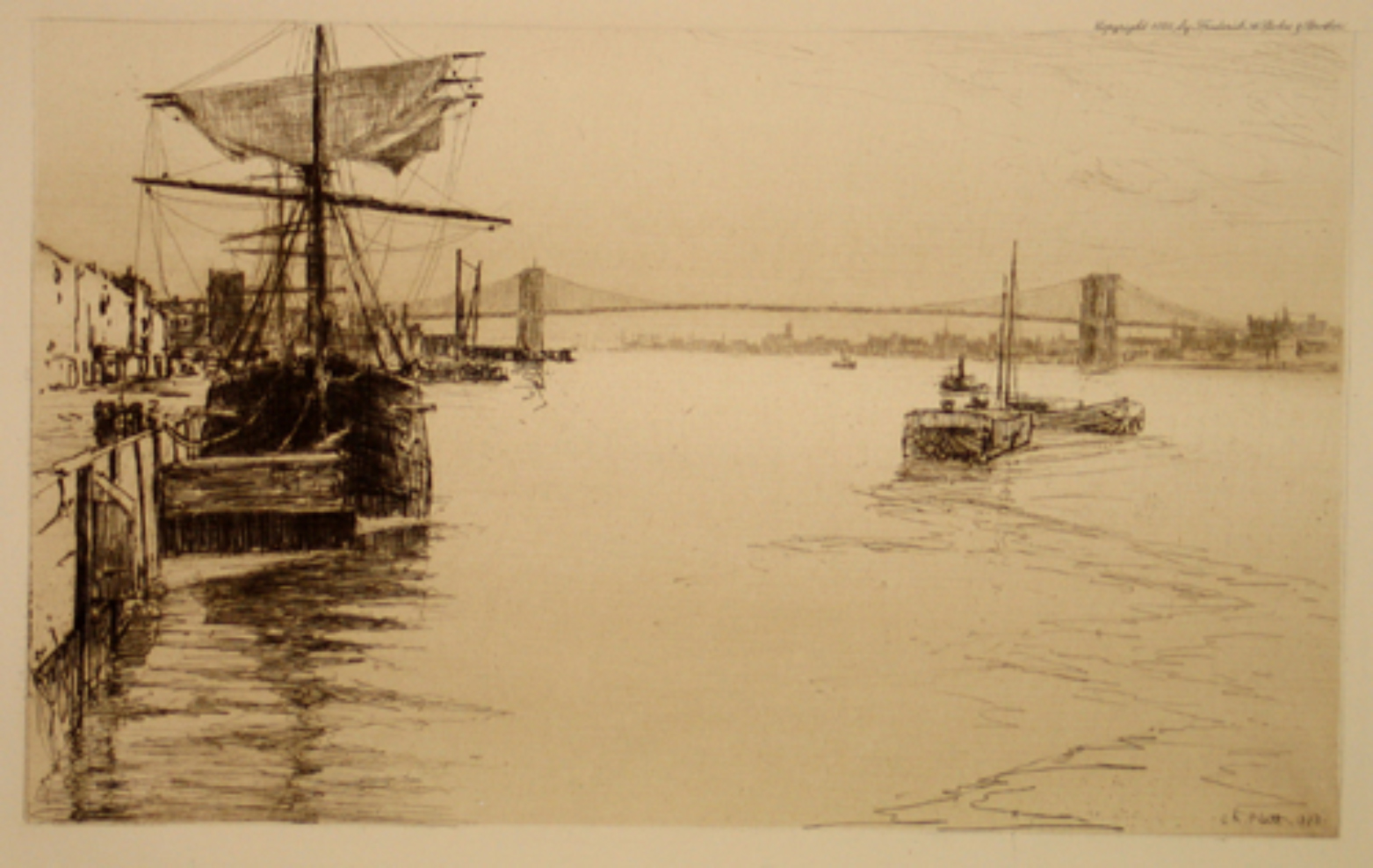
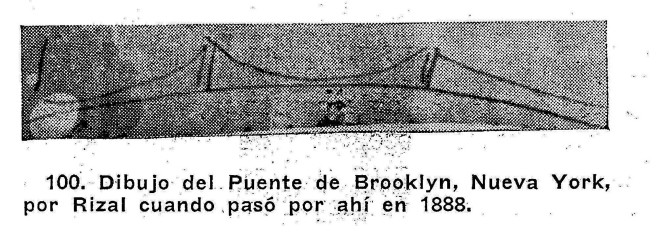
I was surprised to hear his admiration to the revolutionary George Washington rather than Jefferson. Rizal would distance himself from violent revolutions. Rizal has many gifts however; he supplemented his numerous writings with almost instamatic sketches of the places he visited. At the time, the Brooklyn Bridge was completed in 1883 and became the longest suspension bridge in the world. The architecture remains a marvelous sight in East cityscape. Charles Adams Platt, a prominent NY etcher, painted the Bridge in 1888, but I have been looking for the copy of the rough sketches by Jose Rizal. It took me years, and I finally found a copy of his sketch.
I sober up as I saw the Gothic twin towers and steel suspension cable. I drove over this bridge many times as I lived in Brooklyn later in my life. It is the same as it was when Rizal left in New York onboard the City of Rome, the Titanic ocean steamer of the 1880s.
The portrait is worth thousands of words without language to understand or speak. “The City of Rome” is said to be the second largest ship in the world. On board the ship they published a periodical at the end of the voyage. “There I became acquainted with many people, and as I carried a yo-yo with me, the Europeans and Americans were astonished to see how I could use it as a weapon of offense. . . I was able to speak to all of them and understand them in their own languages.”
He has many gifts, and I was fortunate to have his company on my Cinderella Liberty excursion in the Big Apple. There will be more port of calls, let me share it with you.





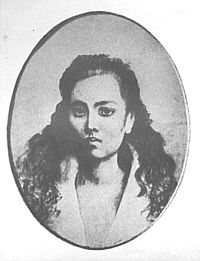 Unfortunately, the affair was doomed in the very beginning. He was boarding in his uncle’s house in Intramuros just starting college, when he met just the 11 years old Eleonor. She was a “pretty woman with a high forehead, soft and wavy hair, almond eyes, small and pensive mouth, and engaging dimples. She was described as a talented, mature, and intelligent lady. She played harp and piano and had a charming voice. She could write and read Spanish. The puppy love blossomed into secret love letters written in different languages including English. Hidden communications because Leonor’s mother was against Leonor pen pal lover. Friendly spies of Rizal informed of her activities from Camiling to Dagupan. They were also distant cousins.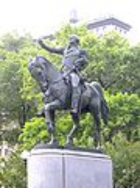

 Filipinohome.com